


These days, it’s easier than ever to start a business online. You can open an Instagram account, sell through a marketplace, and chat with customers through messaging apps. Because of that, a lot of business owners start wondering if having a website is still worth the effort.
At first, it might feel unnecessary. Social media already helps you reach people, post updates, and even make sales. Everything seems to work just fine without a website.
That’s why many small businesses decide to skip it altogether. If customers can find you on social platforms, what else do you really need? It sounds like a reasonable question.
But the conversation around websites hasn’t really disappeared. In fact, it keeps coming up among entrepreneurs, marketers, and business owners. People still debate whether a website is something businesses should prioritize today.
Part of the reason is how quickly the internet keeps changing. New platforms appear, trends shift, and the way people interact online evolves all the time. What feels effective today might look very different a few years later.
Because of that, many businesses are starting to look again at how they build their online presence. Instead of relying on just one or two platforms, they’re thinking about the bigger picture. They want something that feels a little more solid and long-term.
So before deciding that a website is no longer necessary, it helps to look at the situation more carefully. The digital world offers many ways to connect with customers. And that’s exactly why the role of a website is still worth talking about.
Why Your Business Still Needs a Website
Even with so many digital platforms available today, a website still plays an important role for businesses. Social media and marketplaces can help people discover your brand, but they’re only part of the bigger picture. A website gives your business a place online that feels more complete and dependable.
When someone hears about your business, one of the first things they often do is search for it online. They want to see what you offer, learn a little about your brand, and make sure your business looks legitimate. Having a website makes it much easier for people to quickly understand what your business is about.
More importantly, a website brings everything about your business into one place. Instead of sending people to several different platforms, you can guide them to a single destination where they can explore your products, services, and information. From there, it becomes easier for potential customers to take the next step.
1. Your Business Looks More Credible
When people discover a new business online, they usually try to learn a little more before trusting it. They might check the brand name on Google or look for more information beyond a social media profile. This is often the moment when having a website makes a noticeable difference.
A website gives your business a more established presence. Instead of relying only on social platforms, visitors can see a dedicated place that represents your brand. It creates the impression that your business is serious about what it does.
Many customers naturally associate websites with legitimacy. When they find a business with its own website, it feels more professional and organized. This small detail can influence how people perceive your brand.
A website also allows you to present clear information about your business. Visitors can read about your services, see what you offer, and understand how they can contact you. Everything is structured in a way that’s easier to explore.
This becomes especially important when someone is comparing several businesses at once. If one brand provides a clear website while another only has scattered social profiles, the difference becomes noticeable. People tend to spend more time looking at the option that feels easier to understand.
Over time, these small impressions start to shape how customers view your business. A simple website can make your brand look more stable and trustworthy. For many businesses, that perception matters long before a customer even makes their first purchase.
2. You Have Full Control Over Your Online Presence
One of the biggest differences between a website and social media is control. When you use social platforms, you are essentially building your presence on someone else’s platform. The rules, design, and even visibility of your content are decided by the platform.
With a website, your business has far more freedom to shape how it appears online. You can decide how the pages look, what information visitors see first, and how your brand is presented. This allows you to create an experience that truly reflects your business.
Another advantage is that you’re not limited by platform restrictions. Social media profiles usually follow fixed layouts and features that every account must use. A website gives you the flexibility to organize content in a way that makes sense for your business.
It also makes it easier to keep everything in one place. Instead of spreading important information across multiple platforms, your website can act as the central hub for your brand online. Visitors can learn about your business without jumping from one platform to another.
4. Your Business Is Easier to Find on Google
When people need a product or service, one of the first things they usually do is search on Google. They type a question, a problem, or the name of a business they just heard about. This search behavior is still one of the most common ways customers discover businesses online.
A website makes it much easier for your business to appear in those search results. Each page on your site can provide information related to what people are looking for. Over time, this helps search engines understand what your business offers.
Social media posts, on the other hand, are often harder to find through search engines. Most of the content stays inside the platform itself and doesn’t always appear clearly in search results. That means potential customers might miss your business entirely.
With a website, you have the opportunity to create pages that answer questions, explain services, or showcase your products. When those pages match what people are searching for, your business has a better chance of being discovered.
5. Your Website Works for Your Business 24/7
A website continues working even when you are not actively managing it. Once your pages are online, people can visit them anytime they want. It doesn’t matter whether it’s morning, late at night, or during a holiday.
Customers often look for information outside normal business hours. They might want to check your services, browse your products, or read about your business before contacting you. A website allows them to do all of that without waiting for a response.
This also means potential customers can learn about your business at their own pace. Some people prefer exploring information first before deciding to ask questions. A website gives them the space to do that comfortably.
Another benefit is that your website can answer common questions automatically. Basic details like services, pricing information, business hours, or contact methods can all be available on your pages. Visitors don’t need to message you just to find simple information.
Over time, this can also reduce the number of repetitive questions you receive. Instead of answering the same things repeatedly, you can guide people to the information already available on your website. It makes communication more efficient for both sides.
As more people visit your site, your website quietly continues doing its job in the background. It helps people learn about your business, understand what you offer, and decide whether they want to take the next step.
6. You’re Not Fully Dependent on Social Media Platforms
Many businesses today rely heavily on social media to reach customers. Platforms like these make it easy to promote products, share updates, and interact with audiences. But depending entirely on them can sometimes be risky.
Social media platforms constantly change how things work. Algorithms shift, features are updated, and the way posts reach audiences can suddenly become different. What worked well for your business last year might not perform the same way today.
There’s also the reality that your account exists on a platform you don’t control. Policies can change, accounts can be restricted, and platforms themselves can lose popularity over time. These factors can affect how easily customers find your business.
A website gives your business a place online that isn’t tied to the rules of a single platform. Even if social media trends change, your website remains a stable place where customers can still find your business.
How to Start a Business Website
If you’re thinking about creating a website for your business, the good news is that the process is much simpler than many people imagine. You don’t need to be a web developer or understand complicated programming languages. Most business websites today are built using tools designed for regular users.
In general, there are two common ways people start a business website. Both approaches are widely used and trusted by millions of websites around the world. The difference mainly comes down to how much control and flexibility you want.
The first option is using WordPress.com, which provides a hosted platform where many technical things are already handled for you. The second option is using WordPress.org, where you install the WordPress software on your own hosting. Both methods allow you to create a professional website without needing to write code.
Whichever option you choose, you don’t need to become a programming expert to get started. Many business owners with no technical background successfully build their websites this way.
1. Using WordPress.com
One of the easiest ways to create a business website today is by using WordPress.com. Many people know it mainly as a blogging platform because of its free plan, but it actually offers several paid plans designed for professional websites as well. Whether you run a solo business, a small company, or plan to grow into something larger, WordPress.com gives you the tools to build and manage your website without needing technical skills.
One feature that makes WordPress.com especially interesting today is the WordPress AI Website Builder. Instead of building everything manually from the beginning, you can simply describe the kind of website you want and let the AI generate the first version for you. This can make the process feel much less intimidating, especially if you’ve never created a website before.
Here are a few reasons why many people choose the WordPress AI Website Builder:
- You stay in control — The AI helps you create the starting point, but it doesn’t lock you into anything. After the website is generated, you can edit the design, adjust the content, and refine every part of the site however you want.
- Speed — You can go from an idea to a working website in minutes instead of spending days figuring out themes, layouts, and page structures. This allows you to focus more on your business instead of getting stuck on the technical side of building a website.
- Simplicity — You simply describe the type of website you want in plain language, and the AI builds the initial structure for you. This removes the pressure of starting with a blank page and trying to decide where everything should go.
- Real WordPress — The website created is not just temporary AI-generated code or a disposable template. You get a real WordPress.com website with hosting, security, and updates already handled for you.
Getting started with the AI Website Builder is quite simple and doesn’t take much time. The first step is visiting THIS LINK where you’ll find the AI chat interface ready to guide you through the process. From there, you just need to describe the kind of website you want to create for your business.
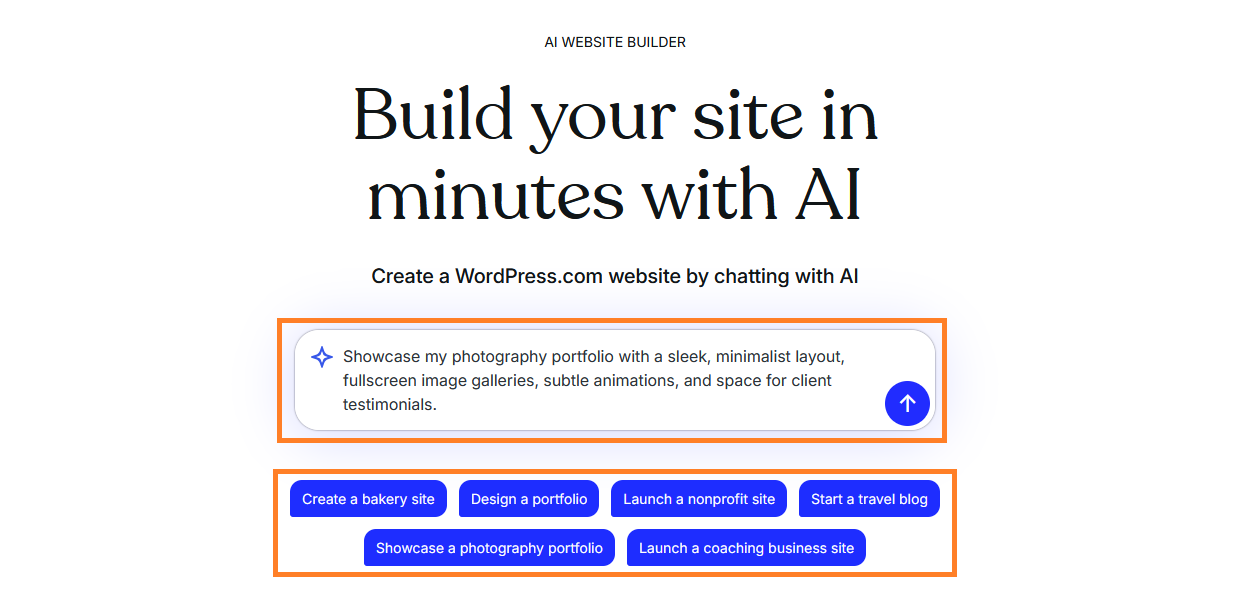
You can write your own description in the chat or choose from several suggested prompts that are already available. The AI will then generate a basic website structure based on what you asked for, including pages, layouts, and sample content. This gives you a starting point that already looks like a real website instead of an empty editor.
Once the site is generated, you can start customizing it inside the WordPress editor. You can change the text, adjust the layout, replace images, and add new pages depending on what your business needs. This allows you to gradually refine the website until it truly reflects your brand.
At the moment, the AI Website Builder is not available for creating eCommerce websites. However, it works very well for most business websites such as company profiles, service pages, portfolios, or informational sites. For many business owners, this approach can save a lot of time compared to starting from scratch with themes, plugins, and page layouts.
Read Also:
2. Using WordPress.org
Another way to build your business website is by using WordPress.org. This option gives you more flexibility and control over your site compared to WordPress.com. However, to use WordPress.org, the first thing you need is WordPress hosting, which is the service that stores your website files and makes your site accessible online. If you’re not familiar with it yet, you can learn more in this article: What is WordPress Hosting?
Choosing the right hosting provider is important because it affects your website’s speed, security, and reliability. One of the best places to get WordPress hosting is Pressable. It’s a managed WordPress hosting platform built specifically for WordPress websites, which means many technical tasks like performance optimization, security, and updates are handled for you.
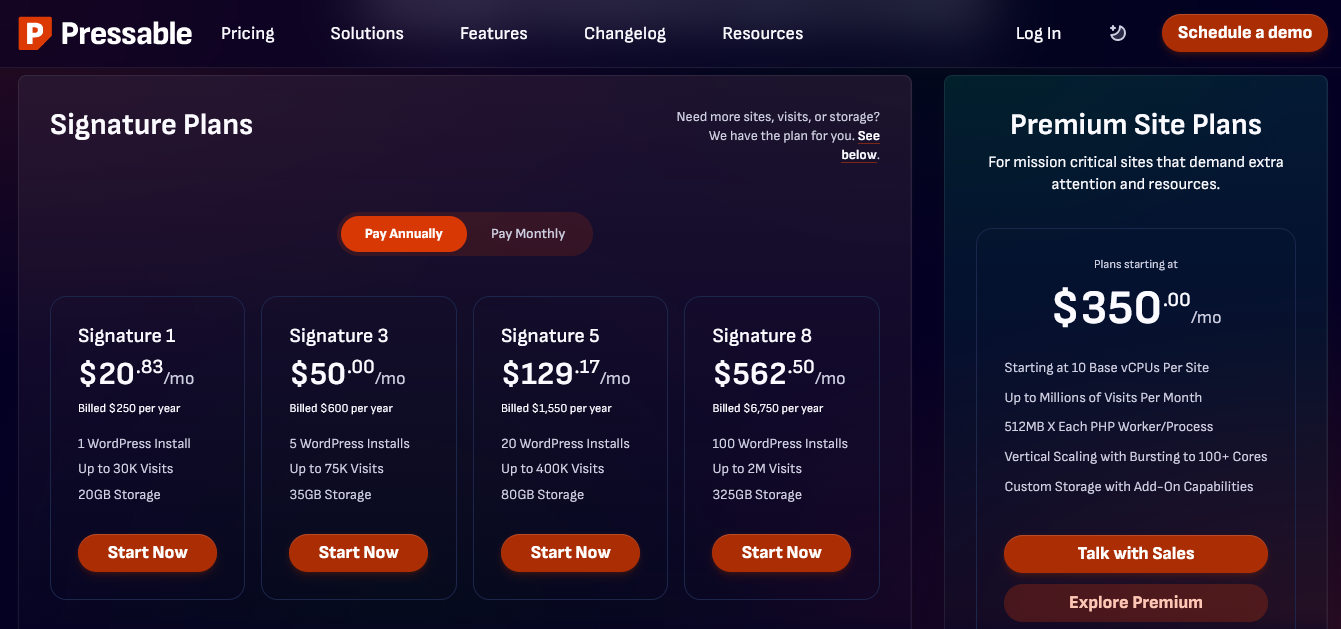
If you’re starting a basic business website but still want better performance than typical shared hosting, you can begin with the Signature 1 plan. This plan is suitable for businesses that need a reliable website with solid speed and stability. It’s a good starting point if your website is mainly used to introduce your business, services, or portfolio.
For larger business websites that require significantly more resources, Pressable also offers the Premium Site plan. This option is designed for websites that handle heavier traffic, larger content libraries, or more demanding functionality. It gives your website the extra performance and scalability needed for bigger operations.
Once your hosting is ready and WordPress is installed, the next step is customizing your website. This is usually done by installing themes and plugins that match what your business needs. If you’re still unsure about the difference between them, you can read more here: WordPress Themes vs Plugins.
Final Thoughts
Even with so many online platforms available today, having your own website still plays an important role for any business. Social media and marketplaces can help people discover you, but a website gives your business a place that truly belongs to you. It becomes the central space where people can learn about what you do and what you offer.
The good news is that creating a business website today is much easier than it used to be. You don’t need to be a programmer or spend months learning technical skills just to get started. With platforms like WordPress, you can build a website that fits your business without making the process overly complicated.
Whether you choose the simplicity of WordPress.com or the flexibility of WordPress.org, both options can help you build a professional website for your business. What matters most is simply getting started and creating an online presence that represents your brand. From there, you can continue improving and growing your website as your business evolves.